
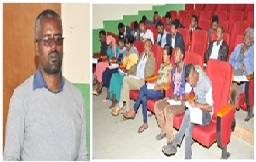
DMU: Basazinew Dires, Debre Markos University Community Service Directorate Training and consultancy officer, opening the training floor states that giving sustainably changing and beneficiary trainings to the community are among the activities that the university is acting on. Thus, the trainees should attain

Partial View of the training
the training attentively and share others so as to empower them.
Debre Markos University Community Service Directorate gives 3 days training to Kebele
Agriculture officers, Extension Agriculture communication coordinators, and Extension Agriculture experts on b
asic concepts and principles Extension Agriculture, participatory Agriculture and Technology Evaluation and creation by the university instructors 19-21 April 2017.
Mr. Ketemaw Melkaw and Mrs titay Zeleke Mr. Aschalew Awoke Mr. Aschalew Markos University Agriculture and Natural Resource college Rural Development and Extension Agriculture Instructors, Give the training on Basic concepts and principles of Extension Agriculture, Participatory, Agriculture, and Technology Evaluation and creation of Agricultural Technology, respectively.
Increament of product and productivity using Extension Agriculture for the sustainable betterment of the life the farmers using selected seeds, artificial or natural fertilizers, using anti-wed, pesticides, ploughing their farm land frequently, harvesting the crops in time, using irrigation and others are the points for the training.
It is noted that Technology creation has crucial importance to improve product and productivity of the peasants. Farmers can improve their lives and play pivotal roles for the economic development of the country if they can always use innovative technologies.
The trainers explain that the training enables to fill the knowledge and skill gaps of the kebele Agricultural Experts, to access Rural Evaluation and Technology creation Services widely to enhance the benefit of the farmers. This will in turn help to strength the relation between the community and the University.
Finally, the participants say that the training egnites them to work so as to improve the lively hood of the peasants. There by, this kind of trainings shall be continuous and be given to similar woredas so that farmers will have better life.