
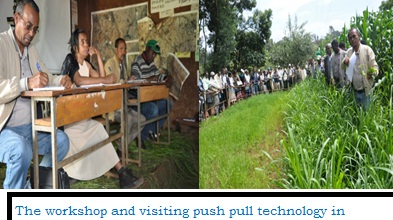
Debre Markos University holds discussions with farmers on push pull technology to prevent stunting, weeds and other related diseases in Libanoskebele, Gozamenworeda Eastern Gojjam Zone.
According to Farmers, Debre Markos University has made significant impact particularly on the product and productivity of maize and sorghum.Debre Markos University has been working to improve the livelihoods of the community in the fight against eradicating bacterial diseases, reducing short-term weeding, reducing soil degradation and improving fertility since the adoption of push pull technology.
Debre Markos University Research Team member Dr. Mesfin Abate expresses that the teams’ commitment on the development of firms and compassionate technology as to develop scientific resistance by designing a new species of mushroom and phoenix grass is encouraging. However, the problem of crop shifting, the size of grazing area, the production of seedy rice for the beneficial fate, the budget problems, the question of the farmers on soil fertility, and the increasing fertility of the soil as the need arises can be added to the demand for agricultural technology and the use of science with technology, Dr. Mesfin added.
In doing so, farmers, agricultural extension experts, kebele leaders and other stakeholders participated in the training on increasing productivity of their yields by improving fertility and using the technology outputs in their farm lands.
Dr. Getnet Atinafu, Debre Markos University Research and Technology Transfer Directorate, explained that the prevention of bacterial pesticides by removing short sprays, stunting that grow in the center of the maize are important for livestock fodder and soil fertility.
It is also noted that the research team will work together with the farmers of other woredas to improve product and productivity.